
Septic Tank Tools
Tanks go on the map with two tools in the System group of Tools > Septic design:
- Tank adds one tank at a time. See Single tank tool.
- Treatment train adds a row of tanks in one go, in the order the wastewater flows through them. See Treatment train tool.
Draw the sewer main from the house first: a new tank is placed on the end of the sewer main and turned along it.
Tank types
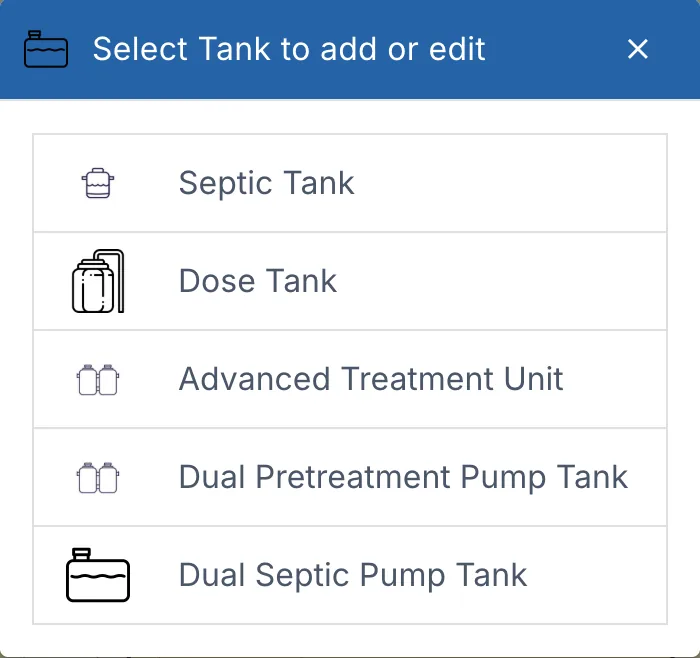
Click Tank to open Select Tank to add or edit. It lists the five kinds of tank you can add.
| Tank type | What it is |
|---|---|
| Septic Tank | The first tank after the house. Solids settle out and the effluent flows on. |
| Dose Tank | A pump tank. It holds the effluent and doses it to the field with a pump or a float. See Dose Tank & Floats. |
| Advanced Treatment Unit | An aerobic treatment unit or other approved unit that treats the effluent further before it reaches the field. See Aerobic Treatment Units. |
| Dual Pretreatment Pump Tank | One tank with a pretreatment compartment and a pump compartment. |
| Dual Septic Pump Tank | One tank with a septic compartment and a pump (dose) compartment. |
The type decides which form Details uses for the tank, how its elevations are worked out and which pump checks apply, so pick the type the tank really is.
Add a tank
- Click Tank, then the tank type.
- Click the map where the tank goes. The tank picker opens, for example Select Septic Tank.
- Click Select on the tank to use. The tank is drawn and its properties open.
The picker lists real tanks of that type that are sold near the spot, the nearest first:
| Column | What it shows |
|---|---|
| Tank | The product and its maker, with notes such as Delivers here, Outside delivery area, Your price or Main distributor. |
| Capacity | The tank's capacity. |
| Delivered and Picked up | The distributor's price delivered to the site, or picked up. |
| Distance | How far the distributor is from the spot. |
| Checked | When the price was last checked. |
Above the list:
- Search tanks, makers or distributors filters the list.
- Willing to pay extra for delivery adds the distributors that deliver beyond their usual area, for a fee.
- Refresh loads the list again.
- Estimated Minimum Required Septic Tank Capacity (septic tanks) is the smallest tank the design flow needs.
A row marked Sponsored is a paid listing. It always fits the design: click Why this? to see why it is shown. If you chose a tank on its product page with Use in design, it is listed first, Chosen on its product page, with Use it.
No tank that fits? Click Add generic septic tank (or the type you are adding) and enter its Capacity, Length, Width and Height.
Advanced Treatment Unit opens Select Advanced Treatment Unit instead: the units approved in your area, with a search box. Click Select on the unit.
To change a tank later, select it on the map and edit its properties. See Component properties. To learn where the products come from, see Products in your design.
Single tank tool
The Tank tile adds one tank at a time: pick the type, click the map, then pick the tank (see Add a tank). Use it to add a tank to a train you already drew, or when the system has a single tank.
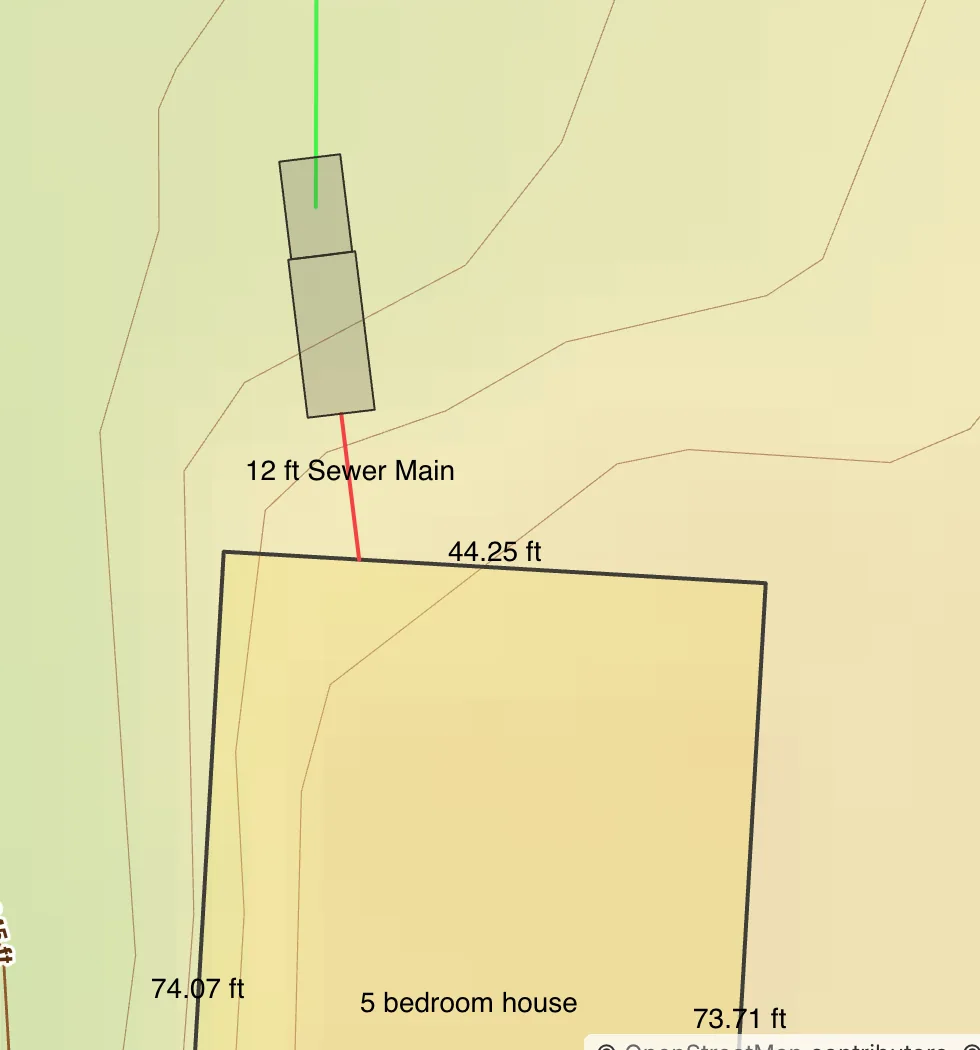
Where the tank goes:
- A sewer main ends within 50 ft of the spot. The tank's inlet is put on the end of the sewer main, and the tank is turned along it.
- No sewer main ends near it. The tank is centred on the spot, turned like the nearest sewer main.
Move or rotate the tank afterwards with the edit tools.
Treatment train tool
A treatment train is the row of tanks the wastewater flows through, for example a septic tank, an advanced treatment unit and a dose tank. The Treatment train tool draws the whole row in one go, and keeps the trains you use often.
- Click Treatment train in the System group.
- Click the map where the first tank goes. Add Treatment Train opens.
- Pick a train under Select a Saved Treatment Train, or build one: click Add next to Add a Septic Tank, Add Dual Septic/Dose Tank, Add a Pretreatment Tank or Add a Dose Tank, and pick each tank in the picker. The tanks are listed in the order you add them.
- Click Draw Treatment Train.
The tanks are drawn in the order of the list, turned like the end of the sewer main nearest to the spot you clicked.
To keep a train for next time, click the save icon (Save treatment train), enter a name under Treatment Train Name and click Save Treatment Train. Remove a tank from the list with its remove button, empty the list with Clear treatment train, and delete a saved train with the delete icon next to its name.
Load local trains
Tank distributors and makers can publish the trains they sell. Load local trains, at the top of Add Treatment Train, copies them into your saved trains.
- Click the map where the first tank goes, then click Load local trains. Local Tank Distributors opens with the tank distributors near that spot and the plastic and fiberglass tank makers that ship there.
- Tick Load next to the companies you buy from, and I have an account with them where you do.
- Click Continue. For a company you have no account with, you can tick Email me their contact details, or Have their sales rep contact me and add how many tanks you order a year and how many days you expect from order to delivery. Each request goes to the company once: if you asked before, the window says when.
- Click Continue again. The companies' trains are listed with their tanks in order, the distributor, the maker when it isn't the distributor, and what the tanks are made of. Tick the ones you want and click Load.
Loaded trains are in Select a Saved Treatment Train, with the company they came from and the date. They are your own copies: change or delete them as you like. Other members' saved trains are never shared.
Related guides
From the landplan.io blog: