
Print settings and page items
The print settings set up the page: Paper and Scale in the command bar above the page, and the tabs On page, Labels, Details and Save beside it. On a laptop the tabs are in the card that Settings opens; on a phone they are in the sheet at the bottom, where Paper and Scale are tabs too. Each change shows on the page straight away. To open print mode, add details and download the PDF, see Print a site plan.
Paper and orientation
Open Paper in the command bar (the Paper tab on a phone), and pick the paper size and which way it turns:
| Choice | What it is |
|---|---|
| Letter | 8.5 × 11 in |
| Legal | 8.5 × 14 in, for counties that take plans only on legal paper |
| Tabloid | 11 × 17 in |
| 24 × 36 | 24 × 36 in |
| Wide | The long side across (landscape) |
| Tall | The long side up and down (portrait) |
The first time you print, the page starts on Tabloid, Wide. After that, landplan.io remembers the paper and orientation you used last. With Fit the site on under Scale, the map refits to the new paper.
Map scale
Open Scale in the command bar (the Scale tab on a phone):
| Choice | What it does |
|---|---|
| Fit the site | Fits everything drawn on the site (the system, tanks and pipes, the house and other buildings, the driveway, soil tests and test pits, wells and your own features) as large as it fits, with a little room around it, in the part of the page the legend, north arrow, scale bar and section leave free, at a tidy scale such as 1 in = 60 ft. The parcel, buffers and county layers don't count. Before anything is drawn, it fits the parcel. |
| 1 in = 40 ft | A common scale for a site plan. On a metric map it reads 1:500. |
| 1 in = 20 ft | A closer scale, for a small site. On a metric map it reads 1:200. |
| Other… | Shows Standard scale, a list from 1 in = 10 ft to 1 in = 2000 ft, and a ft per in box where you type any scale. On a metric map the box reads 1 :. |
The line under the buttons says the scale now, for example Now 1 in = 120 ft. You can also zoom the map in the frame to pick any scale. The title block and the scale bar always show the scale the page prints at.
Title block
The title block runs along the bottom of the page. Click any field in it to type.

| Field | Filled in from |
|---|---|
| Title | The property address, or the map name |
| Address | The township, county and state |
| Parcel ID | The project's parcel number |
| Logos | The landplan.io mark, and your company logo: the logo uploaded on your company's page (Upload a logo, see Company representative). An organization's project shows the organization's logo. |
| Designed by | Your name (empty, it shows + Name) |
| Company, email, licence | Your profile (empty, they show + Company, + Email and + Licence). An organization's project uses the organization's letterhead. |
| Scale and date | Automatic: the page's scale and today's date. Type in them to write your own. |
An empty row isn't printed, and a row you clear stays clear. To change your name, company or licence for every print, see Profile and Preferences.
Switch Title block under Show on the page, on the On page tab, to take it off the page, or put it back.
Legend
The legend lists the layers on the page. It starts in the top left corner of the map.
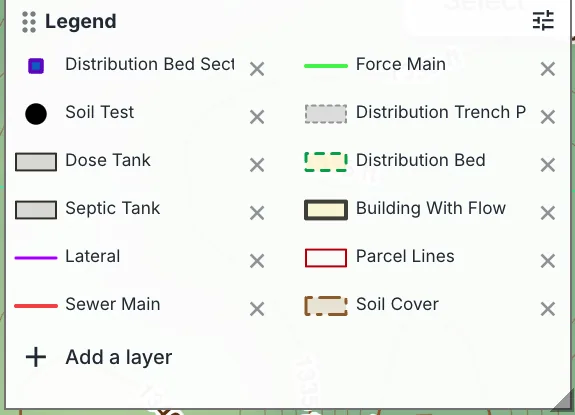
- Move it. Drag it by its handle (the dots before the title) anywhere on the map. Or pick a corner under Legend corner on the On page tab: Top left, Top right, Bottom left or Bottom right. A legend in a corner stays in it as rows come and go.
- Make it wider. Drag its left or right side. Its height follows its rows.
- Rename. Click the title or a row's name and type.
- Reorder. Drag a row to another place in the list.
- Remove a row. Click its ×. Add a layer puts it back, or adds any other layer.
The settings button (the sliders icon) beside the title has:
| Setting | What it does |
|---|---|
| 1 or 2 columns | Lists the rows in one column or two. |
| Text size S, M or L | The size of the legend's text. |
| Title | Shows or hides the legend's title. |
| Only the layers on the page | Leaves out layers with nothing inside the frame. |
| Corner | Puts the legend in a corner, as Legend corner does on the On page tab. |
Helper layers such as measuring lines, buffers and search results are left out of the legend until you add them. Switch Legend under Show on the page, on the On page tab, to take the legend off the page, or put it back. While a detail's box is on the plan, the legend has a Detail area row for it.
North arrow and scale bar
The north arrow turns with the map, so it always points north. The scale bar shows distances at the page's scale, with the scale written under it, for example 1 in = 120 ft.
Drag either one to move it. As you drag, the items on the page snap to the edges and the centre of the map frame and to each other, and guide lines show where they line up. Switch North arrow or Scale bar under Show on the page, on the On page tab, to take them off the page, or put them back.
Section and plan view
+ Section and + Plan view on the On page tab add drawings of the septic system to the page: the section through the bed (A–A) and its plan view. They are drawn from the system's design, like the design report's cross-section sheets.
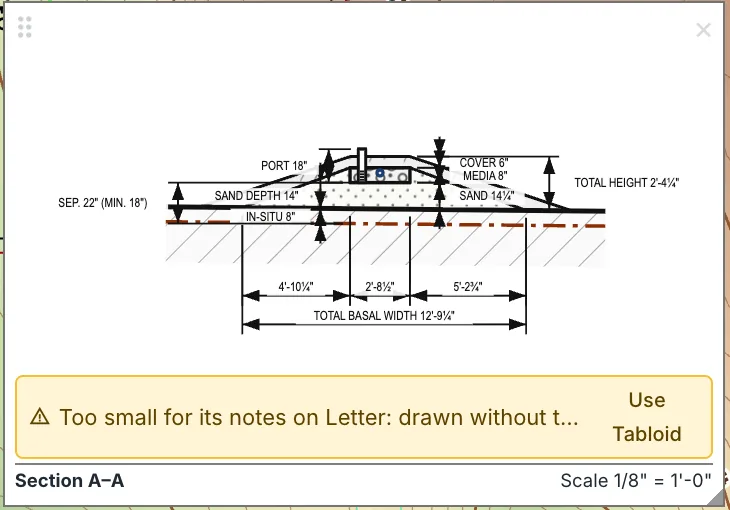
- A new box goes in the corner or side of the page that leaves the drawing the most room, and the drawing moves over beside it: the box never covers what you drew. A box you move stays where you put it; if it lies on part of the drawing, it gets an orange dashed outline.
- When there is little room beside the drawing, the On page tab says so under + Section. Choose On its own sheet to print the section on a second sheet after the plan, with the title block, and keep the plan large. Section on the map puts it back.
- Move a box by its handle (the dots in its top left corner). Resize it from any side or corner. Its × removes it.
- The caption reads Section A–A or Plan view, with the drawing's scale (for example Scale 1/4" = 1'-0") or Not to scale.
- With more than one system on the map, Pick the system (the swap icon) chooses the one the box shows.
- When a box is too small to read on this paper, a warning says so, for example Too small for its notes on Letter: drawn without them. Click Use Tabloid (or the paper it names) to print on a larger paper, or make the box bigger. The warning shows on the screen only.
The two buttons are greyed out when there is no design to draw from. Point at one to see why, for example Draw a system on the map first: the section and plan view are drawn from its design.
Labels
landplan.io tidies the labels when print mode opens. To tidy them again, click Tidy labels for me on the Labels tab. It moves labels a little so they don't cover each other or the features, and hides labels where the map is too crowded. A message says what changed, for example 5 labels moved a little, 2 hidden where too crowded, with Undo. Labels you moved by hand stay where they are.
On the page, with Select on in the page tools:
- Drag any label to where it reads best.
- Click a feature or its label to open its label style, where you change the words, size, colour and more. Click the same spot again to open the next feature underneath.
Side lengths of buildings and areas writes the length of each side along buildings and areas. Pick Small, Normal or Large text, and a colour. The first swatch keeps the colour of the labels.
Undo on the page in the command bar puts back a label you moved. A label a detail takes off the plan (in a box drawn as an outline or as lines, or a keyed note) is left alone by Tidy labels for me and can't be dragged there.
What a click picks
In print mode, the top bar has a What a click picks button (a pointer icon next to Help); on a phone it is on the Labels tab. It opens a small window, Layers a click and the outline can take, with a switch for each layer on the map.
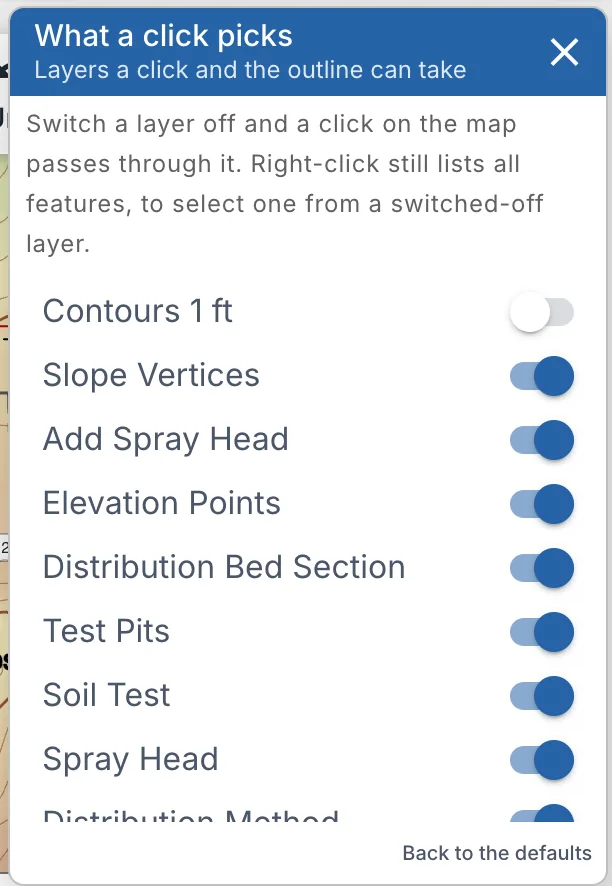
Switch a layer off and a click on the map passes through it to the feature underneath. The outline that shows as you point skips it too. The contours start switched off, so a click on a building over a contour opens the building. A contour's label still opens when you click it.
Right-click still lists every feature under the pointer, so you can pick one from a layer that is switched off. Back to the defaults puts every switch back.
Colour or black and white
Under Colour on the On page tab, pick Colour or Black and white. Black and white shows on the page straight away, and the PDF prints in greys, the logos and the details too.
Keyboard shortcuts
| Keys | What it does |
|---|---|
| Ctrl+P (⌘+P on a Mac) | Saves the map and opens print mode. |
| Ctrl+S (⌘+S) | Saves the map. |
| Ctrl+Enter | In the Text or Callout window of a note you clicked, saves the words. |
The map's undo, Ctrl+Z, is off in print mode. Use Undo on the page in the command bar.