
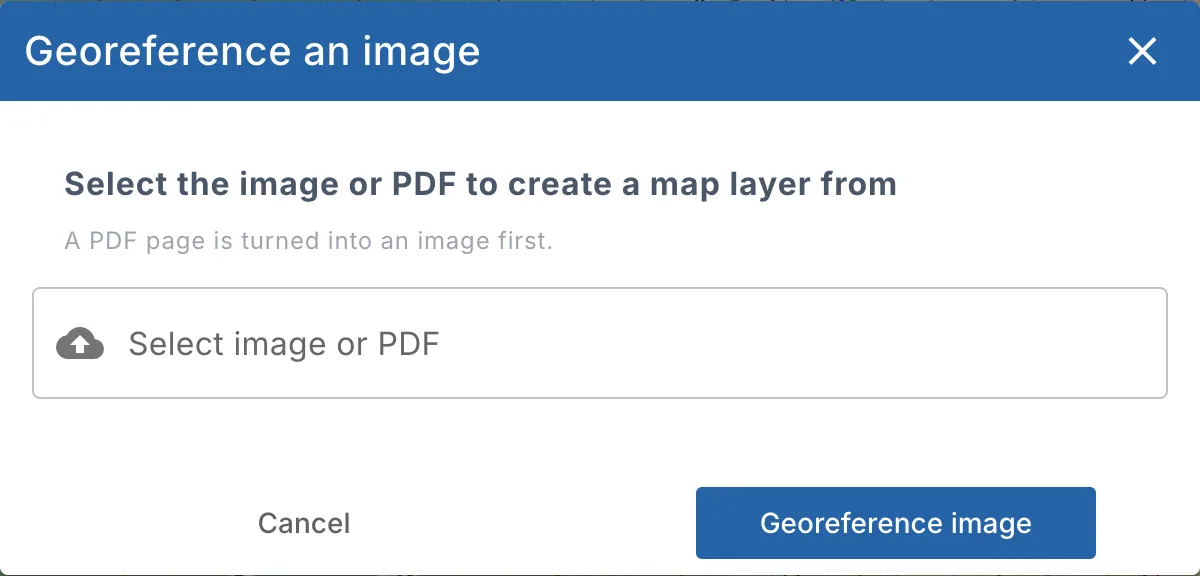
Georeference an image
Often you need to draw over a plan that someone sends you: a surveyor's plat with the house and the corners, a soil evaluator's map of the test pits, or the health department's drawing of the old system. Georef image places that picture on the map, lined up with the ground, as a layer you can draw on.
You can place it in two ways:
- Control points: click a point on the image, then the same point on the map, such as a parcel corner. Two pairs or more place, scale and turn the image.
- Known line: for a plan without points you can find on the map. Click both ends of a line whose length you know, type its length, then drag the plan into place.
Choose the image
- Open Tools > Basic tools and click Georef image (φ), under Map features. The Georeference an image window opens.
- Click Select image or PDF and choose the file: a picture (JPG, PNG and other images) or a PDF.
- For a PDF with more than one page, type the PDF page to use. The page is turned into an image first.
- Click Georeference image.
Video coming soon: Georef image. Until then, follow the steps on this page.
The image is uploaded, and the georeference panel opens along the bottom of the screen: the image below, the map above. If the image can't be uploaded, a message says so and the window stays open: try again. A PDF that is damaged or has a password can't be opened.
Place the image with control points
Find two or more points you can see both on the image and on the map, far apart from each other. Parcel corners, building corners and road crossings work well. Points a surveyor gave coordinates for are best.
- In the panel, choose Control points (it is picked first).
- Click a point on the image.
- Click the same point on the map.
- Do the same for at least one more point.
After two pairs, the image shows on the map, scaled and turned to fit. Each pair you add after that makes the fit better.
- Zoom the image with the mouse wheel, and drag to move around it, to click its points precisely.
- Drag a control point, on the image or on the map, to move it. The image follows.
- Alt+click a control point on the map to delete it.
- Drag the bar at the top of the panel to make the panel taller or shorter.
Place a plan with a known line
Use Known line for a plan with no points you can match on the map, for example a hand-drawn site plan with dimensions.
- In the panel, choose Known line.
- Click both ends of a line whose length you know, such as a dimension on the plan.
- Type its Real length, choose ft or m, and click Scale plan.
- The plan is placed on the map at that scale. Drag the yellow line on the map to move the plan, or its round end to turn it.
To change the length, type it again and click Scale again. If the plan can't be scaled, draw the line again and check its length. You can switch to Control points at any time to pin the plan to points on the map.
Use the placed image
Click the ✕ at the top of the panel to close it. The placed image stays on the map.
- It is listed in the GeoReference folder of the Layers tab. Tick or untick it to show or hide it.
- To see through it to the map, open its ⋮ menu and drag Opacity. See The layer menu.
- Draw your design over it with the usual tools. Snap guides help you draw square to it.
The image is saved with the map, and opens with it next time. To take it off the map, choose Remove folder from map… in the GeoReference folder's ⋮ menu, and confirm with Delete group.
TIP
A plan placed from two points is only as good as those points. Check a third point you know, such as another corner, before you design from it.
You can also start a new project from a plan: see Start from a plan.