
Export GPS points
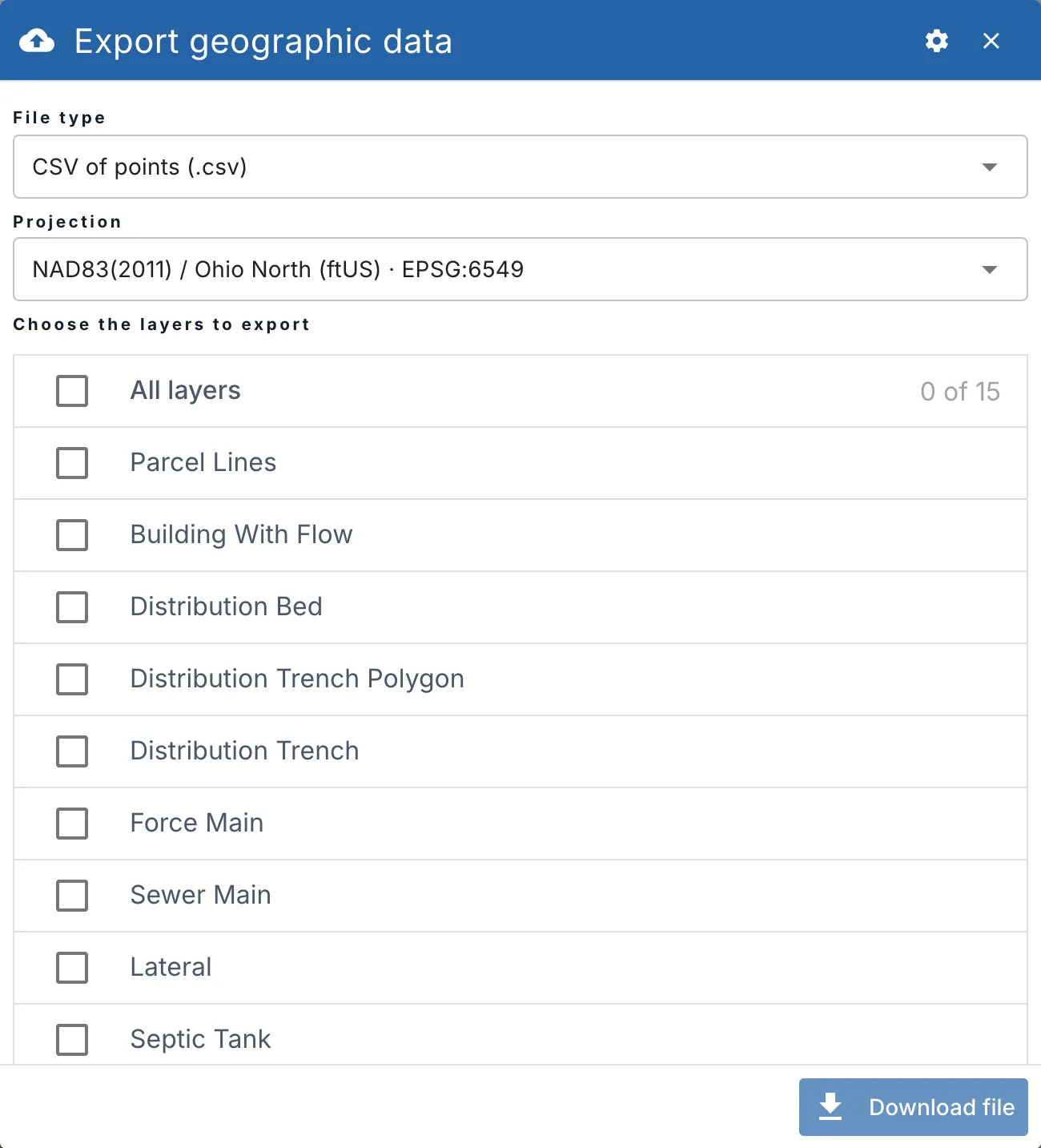
Take your design back to the field. Export data downloads your layers in many formats, GPX and CSV among them. For a CSV of named points to stake out with a GPS unit, with columns you set yourself, use the Export GPS points window.
In short:
- Open Tools > Basic tools and click Export data.
- Under Survey and GPS, click CSV, then Custom GPS columns…. The Export GPS points window opens.
- Pick the File type and the Projection, and tick the layers under Choose the layers to export.
- Click Download file.
Choose what to export
| Field | What it sets |
|---|---|
| File type | CSV of points (.csv), Shapefile (.shp) or GPX (.gpx). For a CAD drawing, the window links to Export to CAD. |
| Projection | The map's projection, for example NAD83(2011) / Ohio North (ftUS), is picked first. Choose WGS 84 (latitude and longitude) for a GPS unit. The project's projection is listed too when it is a different one. |
| Choose the layers to export | The layers that have features. Tick each one to export. |
In the list of layers:
- All layers ticks every layer. It shows how many are ticked, for example 3 of 15. Untick it to go back to the layers you had ticked.
- Buffers groups the setback buffers of the parcel and the buffers you drew, for example Parcel Lines Buffer 10 ft. They are rarely exported, so the group is closed: click it to open it.
- Point at a layer to see its layer id, when it differs from its name.
Download file is greyed out until at least one layer is ticked. The file goes to your downloads folder, named after the county and the parcel number.
What the file holds
| File type | What you get |
|---|---|
| CSV of points | One row per point: each corner of every line and area becomes a point. Points are named after their feature, for example Septic Tank-1-pnt-3 (the feature's name, its number in the layer, then the point's number). |
| Shapefile | A .zip of shapefiles: the features as points, lines and polygons. |
| GPX | Waypoints and tracks for a GPS unit. |
CSV columns
For a CSV, open Change export settings under Columns to set the file's columns.
| Setting | What it does |
|---|---|
| Show names in first row | Adds a header row with the column names. |
| Include ? | Ticks the columns to include: the point name, the two coordinates and elevation. |
| Your field Name | The column's name in the header, for example Y instead of Northing. |
| Max Characters | The longest a value can be. A point name is cut to it; a coordinate or an elevation is rounded to the decimals that fit (a whole part that is longer stays whole). It starts at 20. |
| Order | Where the column goes, from 1. |
Click the gear button (Save these column settings as my default) at the top of the window to keep the settings for next time.
TIP
The coordinate columns follow the projection. In a projected system such as the state plane they are Northing and Easting, in the projection's units; with WGS 84 they are Latitude and Longitude. A name you type under Your field Name stays when you change the projection.
To bring points from the field into the map, see Import GPS points.