
Soil tools
The soil tools put the soil evaluation on the map: where the soil was tested, what the soil is, and which part of the site is good for the system. The design reads them: Smart design, Auto design and the calculator use the soil test nearest the system, and its limiting condition and loading rates.
You don't have to be a soil evaluator to use them. A contractor or designer can type the soil data from a paper or PDF report, or import the report, and still design from it.
A usual way to work:
- Add the soil tests where they were dug, with the Soil test tool, or from the soil test list. Type the GPS position from the report if you have it.
- Describe each test hole: its horizons and limiting conditions. See Soil test forms, or log it in the field with the Soil Field Log.
- Draw the soil boundary the evaluator marked, then right-click it to see which systems fit.
- Design the system: Smart design or Auto design, or the map's own tools.
- Print the site plan and the soil report. See Print a site plan and Create a soil report.
The Soil tools
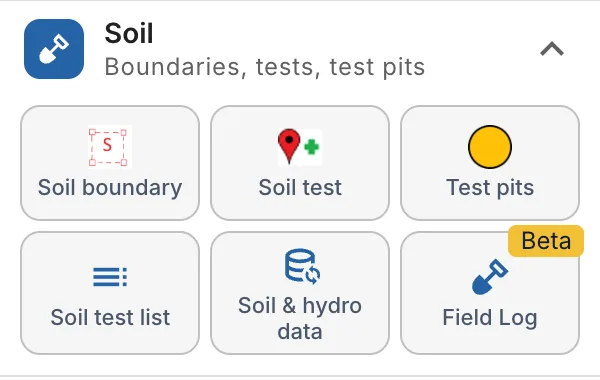
Click Tools in the toolbar, then open the Soil group (Boundaries, tests, test pits).
| Tool | What it does |
|---|---|
| Soil boundary | Draw the soil boundary evaluated in the field. Right-click it to check the fit along the contour or design in it. See Draw a soil boundary. |
| Soil test | Place a soil test on the map and fill in its form. See Soil tests and test pits. |
| Test pits | Mark where test pits were dug. |
| Soil test list | Show or hide the table of the project's soil tests at the bottom of the map. See Soil test list. |
| Soil & hydro data | Show or hide the NRCS soil survey and the water layers. See Soil and hydro data. |
| Field Log | Beta. Log test holes from the surface down, on a phone or a desktop. See Soil Field Log. |
Click a tile again, or press Esc, to turn its tool off. Field Log shows only when the beta is turned on for your account.
Draw a soil boundary
The soil boundary is the area the soil evaluator marked as suitable for the system.
- Click Soil boundary in the Soil group.
- Click the map to add each corner of the area. Double-click to finish.
- Select the boundary to fill in its properties in the Properties tab.
A new boundary is labelled Evaluated soil area (field), and the soil tests inside it are linked to it.
| Property | What it is |
|---|---|
| Name and Label | How the boundary is named on the map and the plan. |
| Source | Where the boundary comes from. A drawn one is Field. |
| Soil scientist | Who evaluated it. |
| Date evaluated | When. |
| Linked soil tests | The soil tests inside it, filled in for you. Change it if you need to. |
| Notes | Anything else for the plan. |
The NRCS soil survey's map units are soil boundaries too: turn on Soil & hydro data to see them. Where a drawn boundary and a survey boundary overlap, the drawn one is the one you design in, and the survey one is kept as a reference.
Soil boundary actions
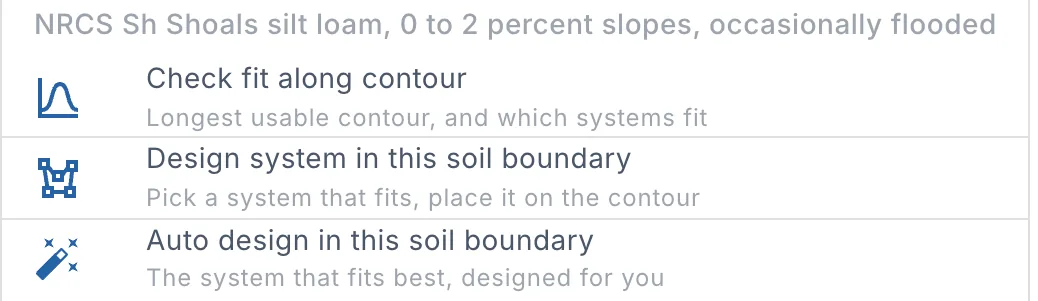
Right-click a soil boundary, drawn or from the NRCS soil survey. The menu shows the boundary's name and three actions.
| Action | What it does |
|---|---|
| Check fit along contour | The usable area, the longest usable contour and which systems fit. See Check fit along contour. |
| Design system in this soil boundary | Pick a system that fits and place it on the contour. See Design in a soil boundary. |
| Auto design in this soil boundary | Auto design picks the system that fits best and drafts it inside the boundary. |
Survey boundaries
A survey boundary is picked by its outline: right-click on the line. Turn on Soil & hydro data, and zoom in to level 15 or closer, to see the lines.
Check fit along contour
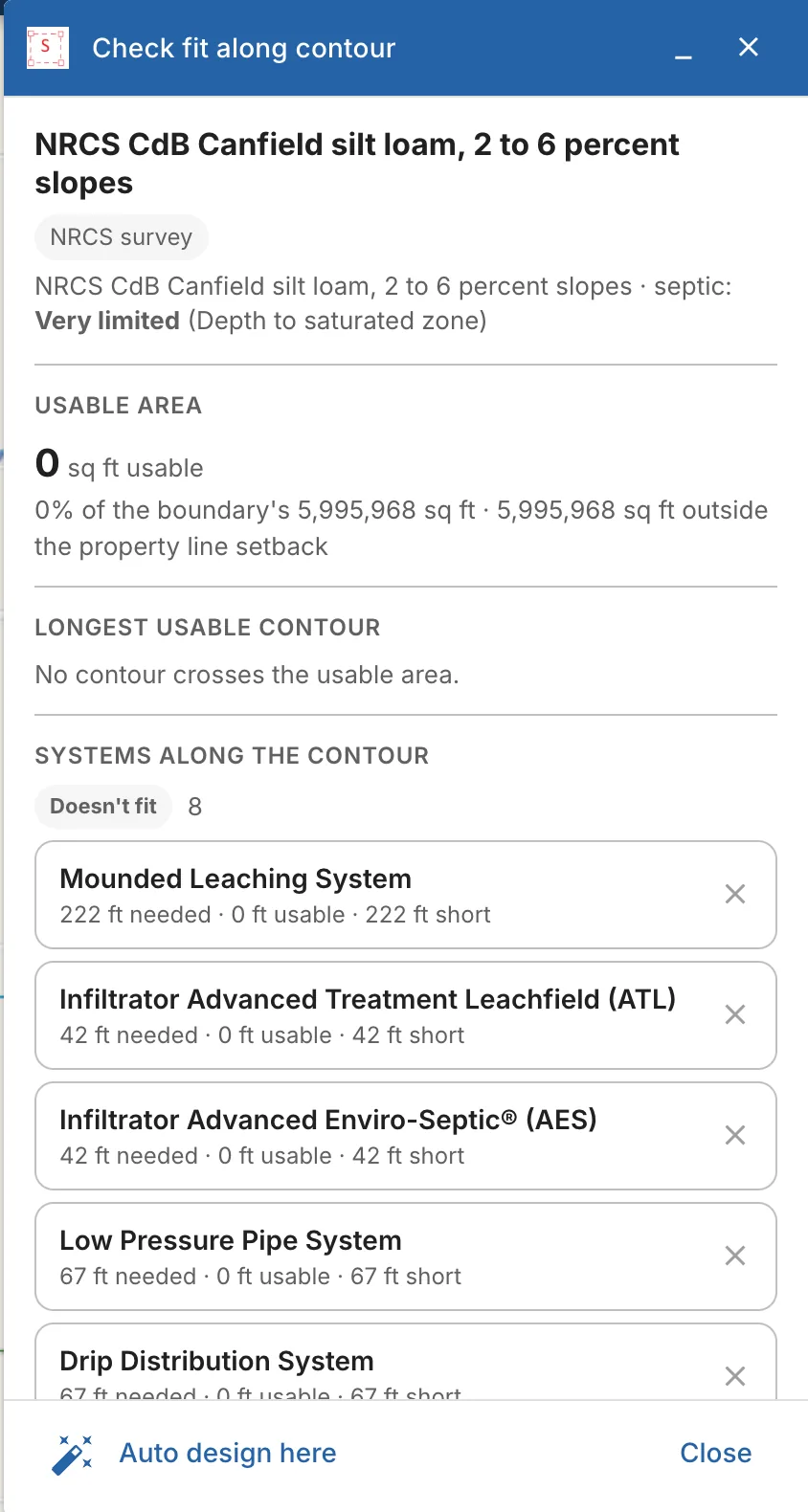
Check fit along contour opens a panel on the right of the map. While it works, it lists its steps: Site and isolation distances, Systems the soil tests allow, Usable area after setbacks, Contours in the usable area and Fit along the contour. Each one is drawn on the map as soon as it is known.
| Part | What it shows |
|---|---|
| The boundary | Its name, Field or NRCS survey, the soil scientist, the date and the linked soil tests. For a survey unit, its NRCS septic rating and the main reason. |
| Usable area | The area left inside the boundary once the setbacks are taken out, and what share of the boundary it is. Each feature that takes area is listed with its setback, and its area is hatched on the map. |
| Longest usable contour | The longest contour line inside the usable area, its length and elevation, and the contour interval. Click the target button to see it on the map. |
| Systems along the contour | Each system of your configuration, grouped as Fits, Fits with a reduction and Doesn't fit, with the length it needs and the length there is. |
Click a system to see why it fits or not, the reduction and where it comes from, and a tip to make it fit. Design it here picks it and goes on to Design in a soil boundary.
Without a soil test result, systems are sized at a default loading rate, and the panel says so. A system your configuration has no form for says to draw it with the contour tool or the system tools.
The panel updates by itself when you add, move or delete an isolation feature. Auto design here runs Auto design in the boundary. Close closes the panel.
Design in a soil boundary
Design system in this soil boundary opens the same panel, titled Design in this soil boundary.
- Pick a system that fits under Systems along the contour.
- Under Where it goes, choose one of the spots found on the contour: A, B or C. Each one says why it was chosen. The letters are shown on the map.
- Click Draw system. Auto design draws the design on that spot, held to the boundary: the system on the contour, with the house, the sewer, the tanks, the distribution and the force main where they are needed.
Check fit only goes back to the fit check. If no spot meets every setback for the system's footprint, the panel says so: try another system, or move the features that take the area.
Auto design in this soil boundary does it all in one press: see Smart design and Auto design.
Soil tests and test pits
A soil test is a point on the map with the test hole's data: who evaluated it, when, its horizons, its limiting conditions and its loading rates.
- Click Soil test in the Soil group.
- Click the map where the hole was dug. The Soil Test window opens with the point's latitude and longitude.
- Fill in the form and click Save soil test.
To open a soil test again, select it on the map, or click Edit in the soil test list. See Soil test forms for each field.
Test pits marks where pits were dug, as points on the map, without a soil form.
To move a soil test, select it and use Move. To delete one, select it and click Delete: the Delete soil test? window lists the tests. Delete soil test deletes them. Hide from map until reload only takes the point off the map for now: the soil test stays saved and shows again when you reload.
Soil and hydro data
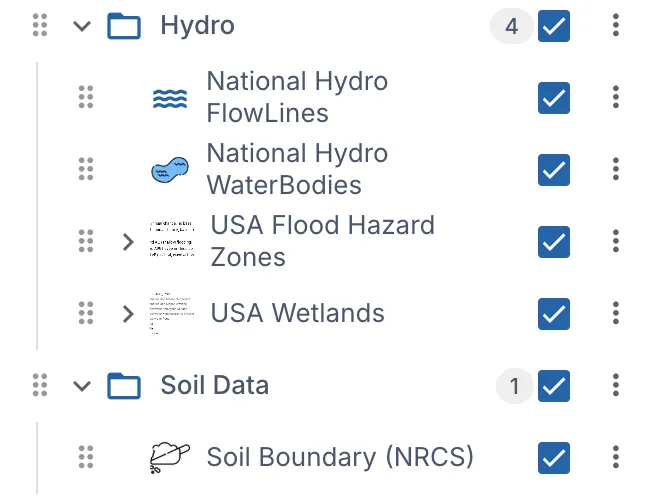
Click Soil & hydro data to show the public soil and water layers. Click it again to hide them. They are added to the Layers panel in two folders.
| Layer | What it shows |
|---|---|
| Soil Boundary (NRCS) | The USDA NRCS soil survey (SSURGO) map units, labelled with their map unit symbol. |
| National Hydro FlowLines | Streams and rivers. |
| National Hydro WaterBodies | Lakes and ponds. |
| USA Flood Hazard Zones | FEMA flood zones. |
| USA Wetlands | The national wetlands inventory. |
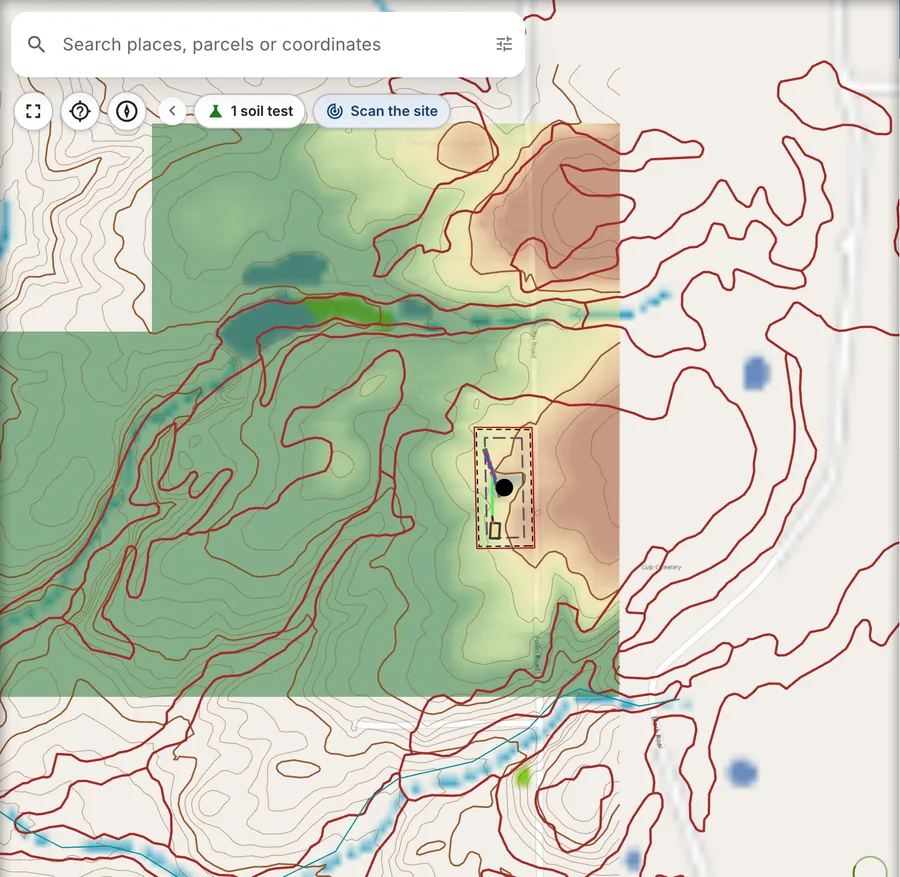
Some layers show only from zoom 15. If you are zoomed out further, a note says which zoom level shows them all.
The survey is a guide to what to expect before you dig. It is not a site test: the field evaluation decides.
Soil insights
Soil insights are the red flags of the NRCS soil survey for the parcel, each with what it means for the design. They are shown in Smart design, under the list of systems in Why these systems: site notes, when your account has the soil insights. The card's summary is in plain words: a soil layer the survey only gives as a code is named (layered loamy sand and gravel), and the septic rating is a sentence (rated very limited for septic fields by the soil survey).
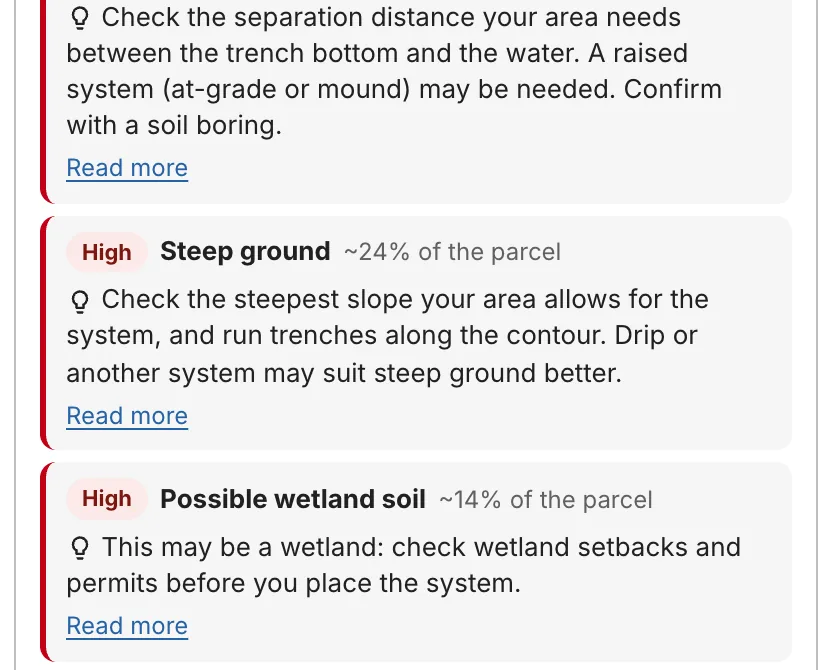
The card's title says how many flags there are: N high, N to check, or No red flags. It opens by itself when a flag is high. Each flag has:
- High or Check, and a title in plain words, for example Water table about 18 in down or Water soaks in slowly, with the share of the parcel it covers.
- What it means for the design, as a tip: what to check against your area's rules.
- Read more: the survey's own finding, the main soil's drainage class, permeability (Ksat), water table, restrictive layer and NRCS septic rating, and the date the survey was read.
| Flag | What it means |
|---|---|
| Rock or hard layer | A standard trench may not fit. Check how much soil your area needs below the trench. |
| Water table | Check the separation your area needs. A raised system may be needed. |
| Soil that stays wet | Keep the absorption area off low spots. |
| Water soaks in slowly | Expect a lower loading rate, a bigger area, or another system. |
| Water drains through too fast | Check the rules on sand fill or pressure distribution. |
| The ground can flood, Water can pool | Keep the system out of those areas. |
| Possible wetland soil | Check wetland setbacks and permits. |
| Clay that swells and cracks | Check your area's rules for clay. |
| Steep ground | Check the steepest slope allowed, and run trenches along the contour. |
| Survey rates the soil poor for septic | An alternative or engineered system is common there. |
Soil insights are advice only. They never change or block a design: your area's rules and the soil test decide. The Soil Field Log uses the same survey to start a new hole's profile.
Related guides
From the landplan.io blog: