Draw or replace the project parcel
The project parcel sets the property lines of the design and the setback buffers drawn from them. When the parcel data is missing, out of date or not accurate enough, draw the parcel yourself, by hand or from the deed, and make it the project's parcel.
In short:
- Draw the parcel: by hand with Parcel, or from the deed with Parcel traverse.
- Right-click inside the new parcel and choose Commit drawn parcel.
- In the Commit Project Parcel window, choose whether to remove the old parcel, and click Commit Parcel.
For where parcel data comes from and how to report a missing area, see Getting accurate parcel information.
Viewing parcel data and any external resources
landplan.io keeps the public parcel data of counties and states, and links to the county's own records where there are any.
- Open Tools > Edit tools and click Select.
- Click inside the parcel on the map.
- Its data shows in the Properties tab: owner records, parcel number, areas and more, depending on the county.
A field with a paperclip is a link to an outside record, such as the county's parcel card or the state's soil or well records. Click it to open it in a new tab. If a link is broken, tell us with Contact us in the help panel.
Draw a parcel from scratch
- Open Tools > Basic tools and click Parcel, under Map features.
- Click the map where the parcel starts, usually a corner you know. GPS points from a surveyor or your own field measurements help: see Import GPS points.
- Click to add each corner. To remove the last corner, press Ctrl+Z or Delete.
- Double-click to close the parcel, or click Finish Editing.
- Right-click inside the parcel and choose Commit drawn parcel. See Change project parcels.
Press Tab while you draw to place the next corner by its bearing and distance. See Drawing on the map.
Draw a parcel from the deed
Parcel traverse draws the parcel from a start point and the deed's calls: the distance and bearing of each side, in order. Type the calls, or paste the deed's legal description and let the window read them. The traverse is drawn on the map as you go, and the window tells you how well it closes.
- Open Tools > Basic tools and click Parcel traverse. The Parcel traverse window opens beside the map.
- Set the Start point: click Pick the start point on the map, then the corner the deed starts from.
- Enter the calls: a Distance and a Bearing for each one, or click Paste calls.
- Check the Closure.
- Click Create parcel, then commit it.
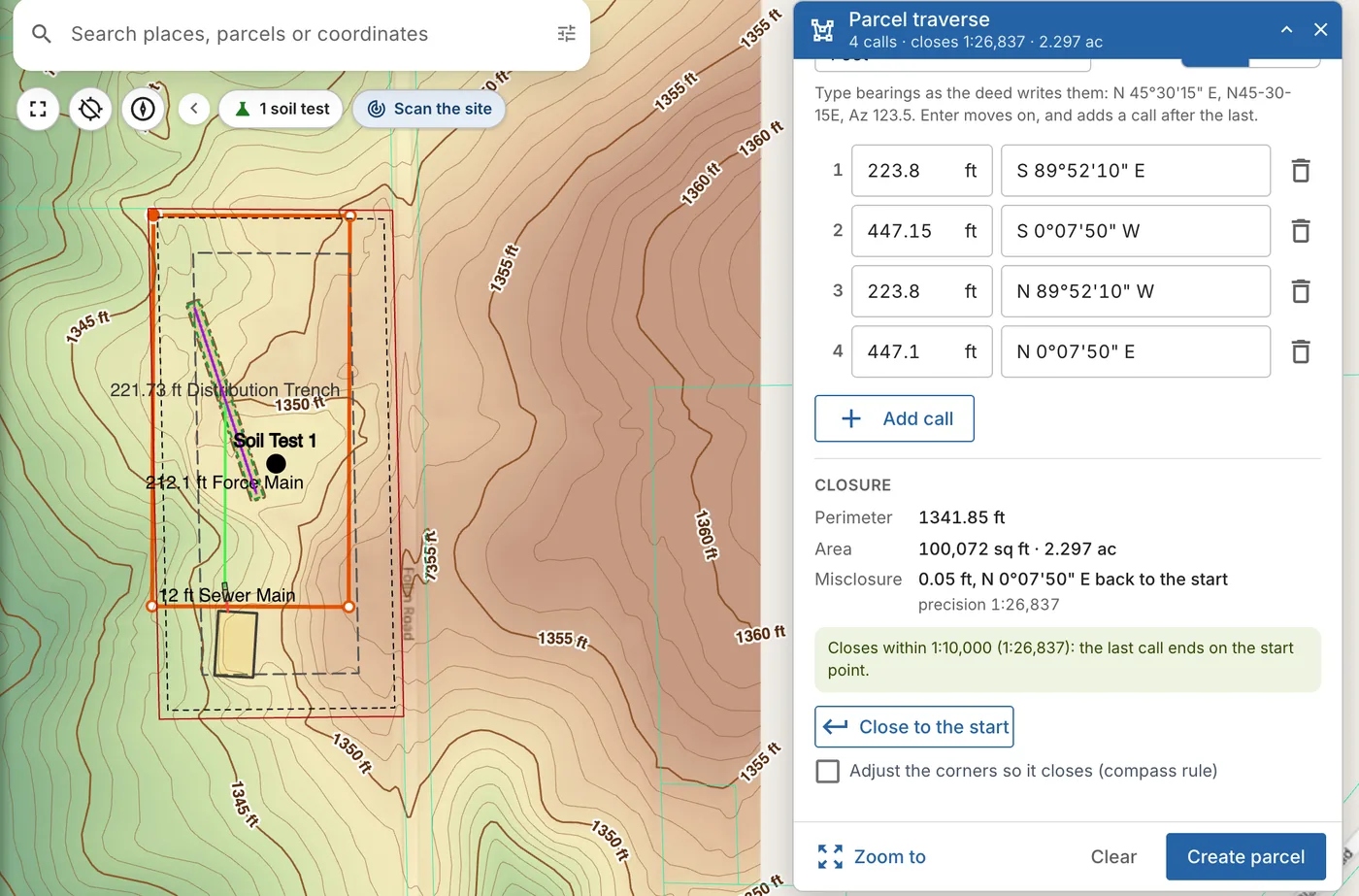
The window
On a computer the window floats over the map, at its top right, and you can drag it by its title. The map keeps the traverse in view beside it as you type. On a phone it is a sheet at the bottom of the map.
The title bar sums up the traverse, also while the window is minimized: for example 4 calls · closes 1:26,837 · 2.297 ac. The arrow minimizes the window to its title, to see more of the map, and ✕ closes it. The window keeps what you entered until you clear it.
The start point
Pick the corner on the map, or type it:
- Pick the start point on the map, then click the corner. A click near an imported GPS point or a parcel corner starts exactly on it. While you pick, the button reads Click the map… (click here to cancel).
- Or type the Lat and Lon, in Decimal degrees or Deg/Min/Sec. The decimal fields also read a pasted latitude, longitude pair.
To start somewhere else, click Pick another start point.
The calls
Each call has a Distance and a Bearing. The window starts with three calls, the fewest a parcel can have. Click Add call for more.
- Distances in sets the unit of all the distances: Feet, Metres, Chains (66 ft), Rods / poles (16.5 ft) or Varas (33⅓ in). Feet are US survey feet.
- Bearings sets how you enter the bearings: Type (one box) or Parts.
With Type, write each bearing as the deed does. The box reads all these forms:
| You type | It reads |
|---|---|
| N 45°30'15" E | North 45 degrees 30 minutes 15 seconds east. |
| N45-30-15E | The same, without marks. |
| S 12 30 W | South 12 degrees 30 minutes west. |
| N 89.5 E | Decimal degrees. |
| North 45 degrees 30 minutes East | Words, as many deeds write them. |
| Az 123.5 or azimuth 123°30' | An azimuth from north, turned into a quadrant bearing (S 56°30' E). |
| N or due east | A cardinal direction. |
While you type, the bearing as read shows under the box, with its azimuth. When you leave the box, it is written the deed's way, for example Az 123.5 becomes S 56°30' E.
With Parts, choose N or S, type the degrees, minutes and seconds, then choose E or W.
A call that can't be read is marked in red, with what is wrong, for example Enter a distance above 0. The map shows the calls before the first one marked in red.
Bearings are read from true north.
Keys
| Press | To |
|---|---|
| Enter in a distance | Go to its bearing. |
| Enter in a bearing | Go to the next call, or add a call after the last one. |
| Ctrl+Backspace (⌘+Backspace on a Mac) | Remove the call. The first three are cleared instead. |
The bin button next to a call removes it too.
Paste calls from a legal description
Click Paste calls next to Calls. You can also paste a description straight into a call's box: when it holds more than one call, Paste calls opens with it.
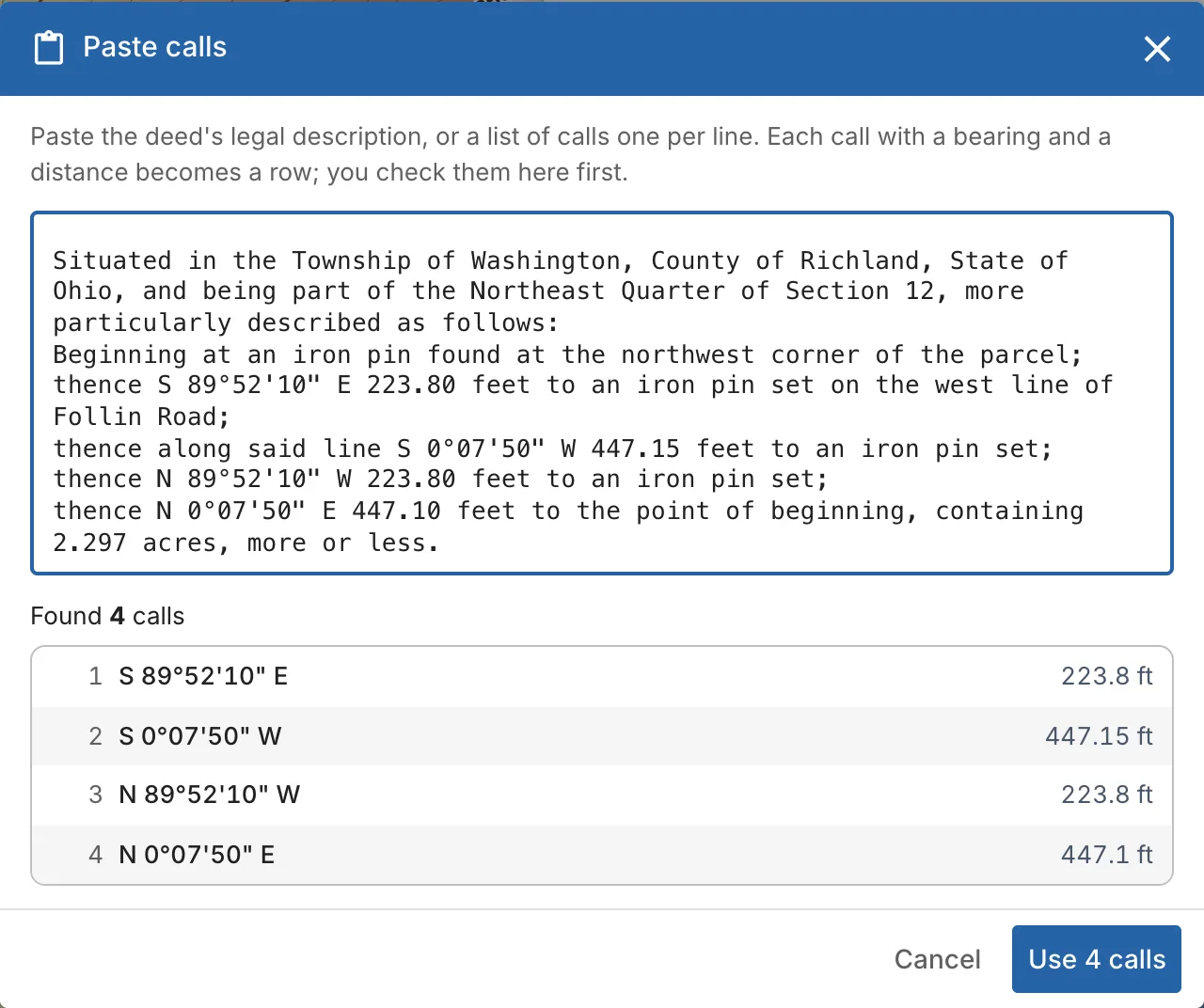
- Paste the deed's legal description, or a list of calls one per line.
- Check the calls found: Found 4 calls, each with its bearing and distance.
- Click Use 4 calls. With calls already in the table, click Replace my calls, or Add after my calls.
What the window does with a description:
- It reads each thence call with a bearing and a distance in feet, metres, chains and links, rods, poles, perches or varas.
- If the deed gives one unit, the traverse switches to it. If it gives none, the distances are read in the window's unit. Calls in mixed units are converted to the window's unit.
- A curve is drawn along its chord, from the chord bearing and length the description gives. The call shows A curve: drawn along its chord.
- The lines it couldn't use are listed under Not read, with why, for example No distance found, or A curve without its chord bearing and length: enter its chord as a call.
- The calls of a Commencing at … to the point of beginning tie line are left out: they lead to the parcel, they aren't its sides. A Beginning at … line that places the start by a bearing says Describes the starting point: pick it on the map.
Check the calls against the deed before you use them.
The closure
Under Closure, the window shows:
| Line | What it is |
|---|---|
| Perimeter | The length of all the calls. |
| Area | In square feet and acres (square metres and hectares in metres). |
| Misclosure | How far the last call ends from the start, and the bearing back to it, with the precision, for example precision 1:26,837. |
These are worked out on a plane, from the calls, the way a surveyor checks a deed: a deed that closes on paper closes exactly here.
The note under them grades the closure:
| The note says | What it means |
|---|---|
| The calls close exactly | The last call ends on the start point. |
| Closes within 1:10,000 or 1:5,000 | A small misclosure, normal for a deed. The parcel closes on the start point. |
| Large misclosure | Check the calls for a mistyped bearing or distance. |
| The last call ends … from the start | The calls don't come back: the parcel closes with a dashed line to the start. |
When it doesn't close exactly:
- Close to the start adds a last call from the end back to the start point.
- Adjust the corners so it closes (compass rule) spreads the misclosure over the corners, in proportion to the distance to each one, so the traverse closes.
Create the parcel
Click Create parcel. The parcel is added to the Parcel layer and selected, and a message says Parcel added to the Parcel layer, with the number of calls and the closure. Its sides are labelled with their calls.
Create parcel is greyed out until the traverse is ready. Point at it to see why: Set the start point first, Fix the calls marked in red first, or Enter more calls: a parcel needs at least 3 corners.
- Zoom to zooms the map to the traverse.
- Clear starts over. With calls in the table, it asks first: Clear the start point and 4 calls? Click Clear, or Keep.
The new parcel is a drawing until you commit it: see the next section.
Change project parcels to another existing parcel
A parcel becomes the project's parcel when you commit it. Committing draws the property lines and the setback buffers from it. You can commit a parcel you drew, a county parcel next to the project, or several parcels at once.
- Right-click inside the parcel on the map.
- Choose:
- Commit drawn parcel, for a parcel you drew or traversed.
- Commit county parcel, for a parcel from the county parcel data.
- Commit all parcels here, when more than one parcel is under the click.
- In the Commit Project Parcel window, choose:
- Remove old parcel: tick it to replace the project's parcel. Leave it unticked to add the new parcel beside it.
- Move the soil tests to the new parcel: they keep their places relative to the parcel. Any that would land outside it are spread inside it: check their locations after.
- Click Commit Parcel.
Both choices show only when the project already has a parcel. A parcel that is already the project's parcel isn't offered again. See also Map context menu.
Combine two or more existing parcels
To make one project parcel from neighbouring parcels, trace their outside edge.
- Right-click inside one of the parcels and choose Commit county parcel, so its lines are on the map.
- Open Tools > Basic tools and click Parcel.
- In Edit tools, click Snap and turn on snapping to the parcel lines. See Snapping.
- Click along the outside corners of the parcels. Each click snaps to a corner.
- Double-click to close the new parcel.
- Right-click inside it, choose Commit drawn parcel, and tick Remove old parcel.