
Septic System Cost: What Drives the Price
Short answer: a septic system's price is set mostly by the site. Soil that takes water well and sits deep above the water table allows a simple gravity trench system, usually the lowest-cost option. Shallow, slow or wet soil calls for a mound, a pressure system or a treatment unit, which cost more to build and to run. The tank, the drain field media, a pump, the digging, the design and the permit make up the total. Your state's and county's rules decide which systems you can use.
This guide is for homeowners, builders and installers who need a realistic picture before they get quotes. We don't quote national averages here: they hide too much. Instead, we explain what you pay for and point you to live prices: the landplan.io price index shows what distributors charge for tanks, pipe, chambers and other parts, by state.
What the price of a septic system includes
Every quote is made of the same parts, even when they arrive as one number. Ask your installer to break it down.
| Part of the cost | What it covers | What moves it |
|---|---|---|
| Site and soil evaluation | Test pits or borings, a soil description, sometimes a perc test | Who may do it in your state, how many holes the county wants |
| Survey or site plan | Property lines, the house, wells, slopes | Whether a licensed survey is required |
| Design | Sizing, drawings and calculations for the permit | System type, how complex the site is |
| Permit and inspection fees | Health department or county fees | Set locally |
| Septic tank | The tank, delivered and set | Size, material, distance from the supplier |
| Drain field (absorption area) | Stone or gravelless products, pipe, sand fill for a mound | Size from the soil's loading rate, system type |
| Pump and dose tank | Only for pumped or pressure systems | Lift, distance, control panel |
| Treatment unit | An aerobic unit or media filter, where required | Product, plus power and service |
| Excavation and labor | Digging, setting, backfill, grading, seeding | Access, rock, trees, local labor rates |
| Restoration and extras | Risers, lids, alarms, driveway crossings | The site |
The EPA describes a septic system as a tank and a drain field in unsaturated soil. Everything beyond that, a pump, a sand mound or a treatment unit, is there because the site needs it, and each one adds cost.
Cost by system type
The table below ranks system types by how their cost usually compares. It is not a price list: what each costs in your area depends on the site and on local prices. The EPA's own descriptions of the types of septic systems note, for example, that sand filters "are more expensive than a conventional septic system", and its mound fact sheet says mound construction costs "are typically much higher than conventional systems".
| System type | Why it costs what it does | Usually compared with a gravity trench system |
|---|---|---|
| Gravity trench (conventional) | Tank, distribution box, trenches of stone or a gravelless product | The baseline |
| Chamber trenches | Plastic chambers instead of stone; some states allow a smaller area | Similar; depends on stone prices and any area credit |
| Low pressure pipe (LPP) | Adds a dose tank, pump, controls and small pressure laterals | Higher |
| At-grade bed | Pressure-dosed bed on the ground surface, with a soil cap | Higher |
| Mound | Sand fill brought in by the truckload, a pump, pressure laterals, more design work | Considerably higher |
| Drip distribution | Tubing, filters, a timer-dosed pump and often a treatment unit first | Higher, with more maintenance |
| Aerobic treatment unit (ATU) | The unit itself, power for its aerator and a service contract in many states | Higher to build and to run |
| Sand or media filter | The filter, its media and often a pump | Higher |
| Spray irrigation | Treatment unit, disinfection, pump and spray heads | Higher, with ongoing service |
For what each system is and when it is used, see Septic System Types.
What drives the cost on your lot
The soil
The soil decides how big the drain field must be and how deep it can go. A soil that takes effluent slowly needs a larger area. A seasonal high water table, bedrock or a dense layer close to the surface may rule out trenches and push the design to a mound or a pressure system. That single finding often matters more than anything else on the quote. See Perc Test vs Soil Evaluation.
The size of the house
Most states size a home's system from its number of bedrooms, not the number of people. More bedrooms means a higher design flow, a bigger tank and a larger drain field. See Septic Tank Size and Drain Field Size.
Local rules
Setbacks from wells, streams and property lines decide where the system fits. Some counties require a reserve area, pretreatment near sensitive water, or a licensed designer or engineer. Fees vary from place to place. Each state's rules and costs are summarized on the septic pages by state, for example Ohio.
Products and delivery
A septic tank is heavy, and most of its price after manufacture is getting it to the site. Concrete tanks usually come from a precast plant within a delivery radius; beyond it, you pay by the mile or need a boom truck. Sand, stone and pipe are priced at the yard and trucked in. The same tank can cost noticeably more on a remote lot than near the plant. See Septic Tank Suppliers.
The site itself
Steep ground, trees to clear, rock to break, a long run from the house, a driveway crossing or poor access for a truck all add labor. A replacement on a lived-in lot adds restoration of lawns and landscaping.
Real prices: the landplan.io price index
We publish what distributors actually charge. The price index collects delivered prices from distributors' listings on landplan.io and shows, for each product type, the median price and the range most listings fall in, nationally and by state (for example prices in Ohio). A type is published for a state only when there are enough listings to say something useful.
Use it to check the product side of a quote: if the tank on a quote is far above the range in your state, ask why. It might be a larger tank, a special material or a difficult delivery, all good reasons, but you should know which.
The index covers products, not labor. Labor, excavation and design vary much more between installers and regions, and we don't publish averages for them. How much data we have, by state, is on the data coverage page.
How to get an estimate for your own lot
A useful estimate starts from a design, because the design decides the quantities. In landplan.io:
- Type the address. The parcel, its elevation, the soil survey and the setbacks load onto the map.
- Let Smart design or Auto design pick a system that fits the parcel and your county's rules, or draw it yourself.
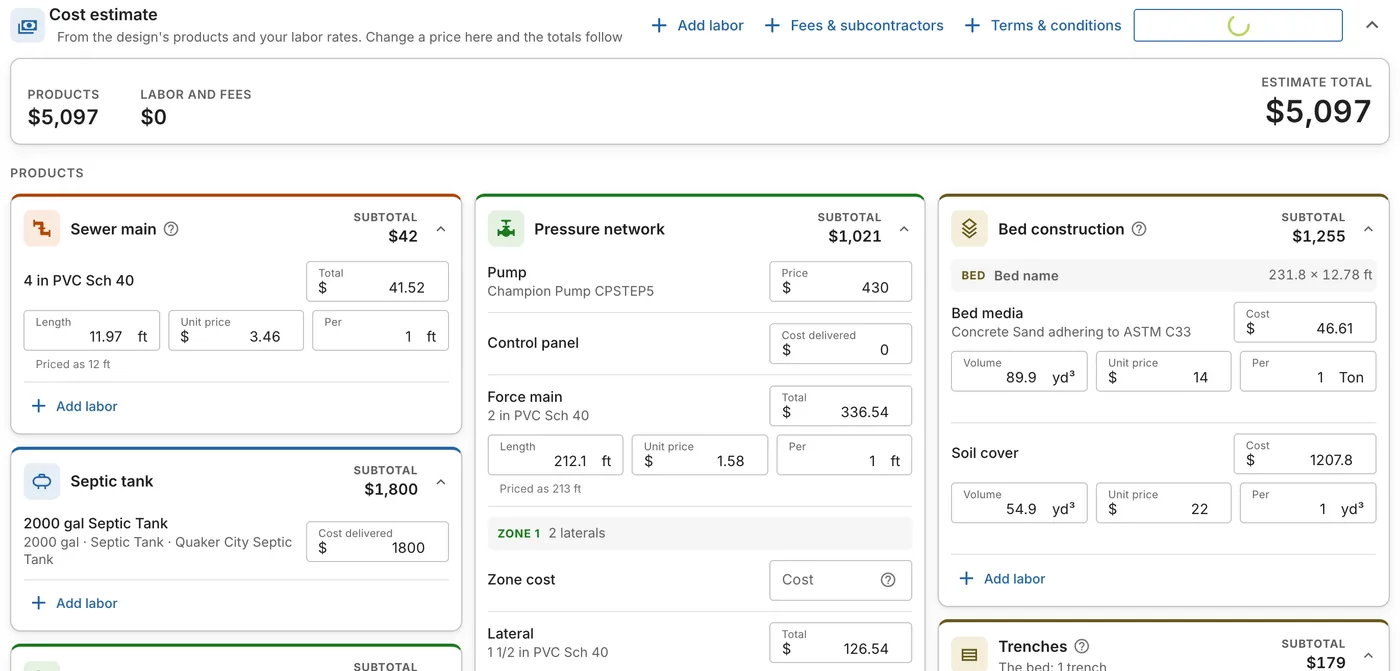
- Open the cost estimate. Each tank, pump and pipe in the design carries a real product price from a distributor near the site, with an approximate delivery price per seller. Bed media and sand are priced by the volume the design needs.
- Add your labor, fees and terms, and download the estimate PDF.
Move a part or change the system, and the estimate follows. See Cost Estimate and Distributors and Products.
Costs after installation
A septic system has running costs too. The EPA says household septic tanks are typically pumped every three to five years, and that the average system should be inspected at least every three years, with systems that have mechanical parts generally inspected once a year. A pump, an aerator or a UV light uses electricity and eventually needs replacing. Many states require a maintenance contract for an ATU or a spray system.
When you compare two designs, compare what each costs to own over the years, not only what it costs to build.
Ways to keep the cost down
- Get the soil evaluated first. The finding decides the system. Don't price a house plan before you know it.
- Site the system well. A spot with deeper soil, a gentle slope and room inside the setbacks can mean a simpler system. A designer can compare spots before you pour a foundation.
- Size the house deliberately. Each bedroom adds design flow in most states. A room labelled "office" may still count as a bedroom, so ask your health department how they count.
- Compare delivered prices. Check the products against the price index and look for suppliers closer to the site on septic companies by state.
- Ask about approved alternatives. Some states give an area credit for chambers or for pretreatment. Your designer knows what your county accepts.
Frequently asked questions
Why do septic quotes vary so much for the same house?
Because the site, not the house, decides most of the cost. Two installers may also assume different systems, tank materials or delivery routes. Ask each one for the system type, the tank size, the drain field area and what the quote leaves out (permit fees, design, restoration).
Is a mound always more expensive than a trench system?
In nearly every case, yes. The EPA's mound fact sheet says mound construction costs are typically much higher than conventional systems, because of the sand fill, the pump and the extra design. But a mound may be the only system your soil allows.
Does a replacement cost more than a new system?
Often it does, because the old system has to be dealt with, the yard is already landscaped, and the best spot may be taken by the old drain field. Some areas also require an upgrade to today's rules.
Can I see septic tank prices for my state?
Yes. The price index shows delivered prices by state and product type, where enough distributors list them.
Who decides which system I can install?
Your local health department or state agency, from the soil evaluation and the design. Start with your state on the septic pages by state, and see Septic Permit Process.
Design it from your address
The fastest way to a real number is a real design. Create a free account, type the address, and landplan.io designs a system that fits the parcel and your county's rules, with a cost estimate from products distributors near you stock.