
Why the Age of AI Needs More Surveyors, Not Fewer
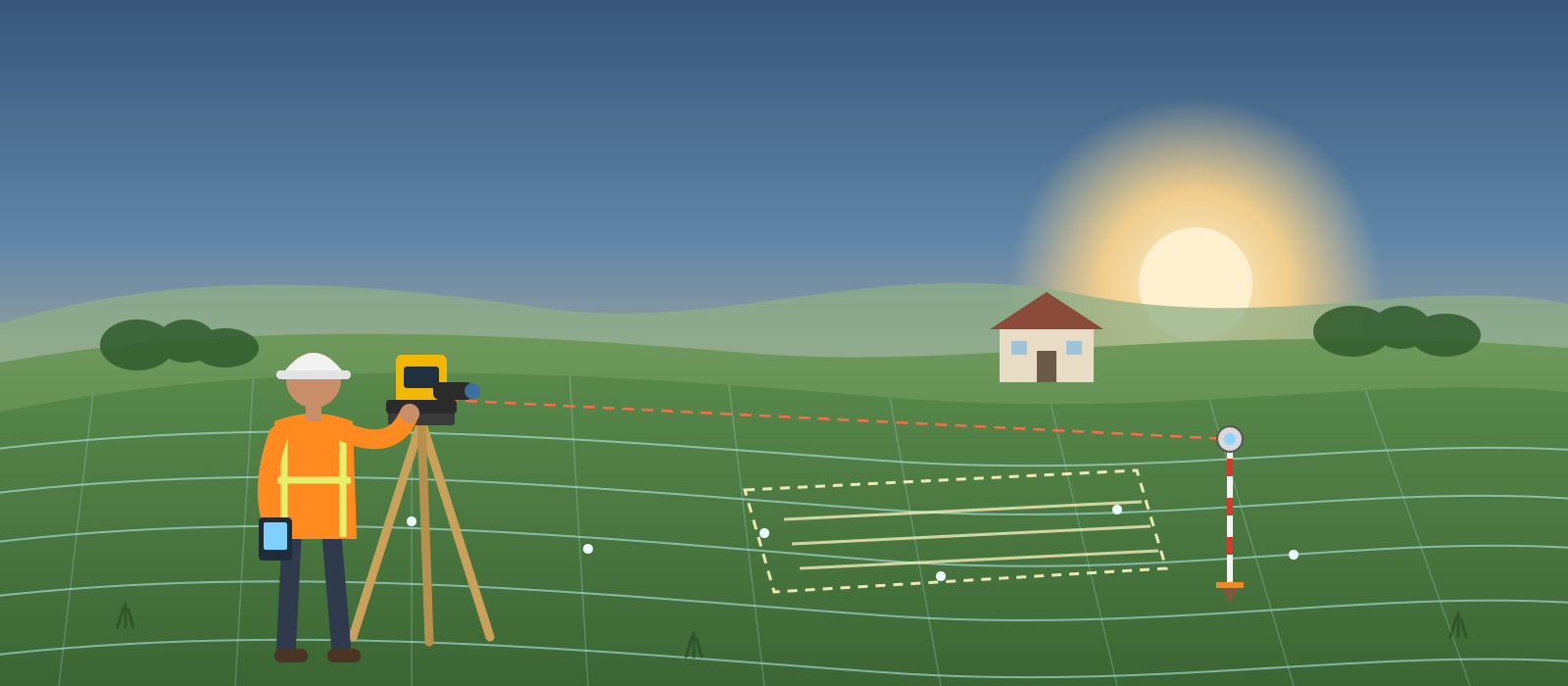
AI will make lot development faster, but only if we have enough licensed surveyors to stand behind the results. That's the conclusion I've come to after a few decades of helping plan onsite wastewater treatment systems.
Everything I've learned along the way, from soil tests and setbacks to the many ways a lot can surprise you, has gone into landplan.io. Building it has shown me how much software can now do. It has also shown me exactly where software stops.
Here's my take: in the age of AI, we're going to need more surveyors than ever, not fewer.
What AI is already good at
AI is very good at the data side of lot development. It can pull together in minutes what used to take days of digging through county records and map layers.
For onsite wastewater planning, that means tools can now:
- Overlay soil survey data, slopes, wetlands and floodplains on a parcel
- Check draft layouts against setback rules for wells, property lines and surface water
- Flag the parts of a lot most likely to support a drainfield
- Produce a first-pass site plan that a professional can refine
That's real progress. It cuts down the guesswork and the back-and-forth that slows projects down.
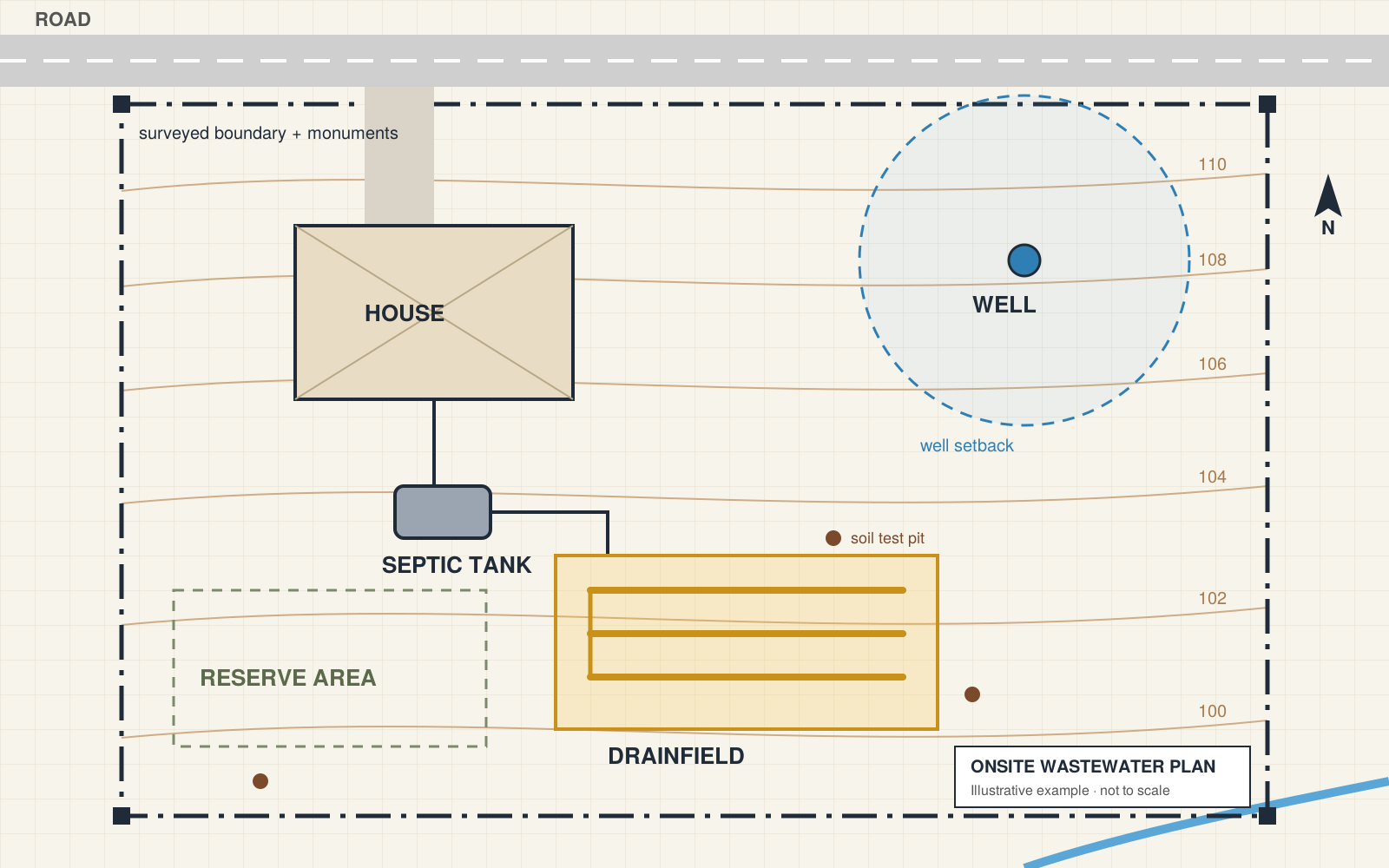
Every line on a plan like this depends on where the boundary, the well and the contours really are. AI can draft it. Someone still has to verify it.
What AI can't do: put its name on the line
AI can process data, but it can't take responsibility for it. Regulators reviewing a subdivision plat or a septic permit don't just want an answer. They want a qualified geographic expert who has checked the work and is willing to put their license on it.
That's what a surveyor's stamp means. It says a licensed professional verified where the boundaries are, where the benchmarks sit, and how the ground actually lies. If something is wrong, there is a person accountable for it.
No model can carry that liability, and no review board is going to accept "the software said so." Nor should they. A drainfield placed a few feet off, or on the wrong side of a boundary, can mean a failed system, a contaminated well, or a lawsuit.
Put a surveyor in the loop, and everything moves faster
The fastest path isn't AI instead of surveyors. It's AI with a surveyor in the loop. Let the software do the screening and the first draft, and let a licensed professional verify it and put their name on it.
When the surveyor gets a solid draft instead of a blank page, they spend their time where it counts: in the field and on judgment calls. Regulators get a plan they can trust, and the lot moves to permit sooner. That includes onsite wastewater planning, where the right drainfield location depends on getting the ground truth right.
The bottleneck: there aren't enough surveyors
The problem is that surveyors are in short supply, and the gap is getting wider. The U.S. had about 52,000 surveying jobs in 2025, according to the Bureau of Labor Statistics. That's fewer than the 56,200 it counted back in 2010, as Geo Week News reported.
Meanwhile, the people doing the work are getting older. Industry estimates put the average licensed land surveyor in their late 50s, and Land Surveyors United reports that two or three surveyors are heading toward retirement for every new one coming in.
BLS expects about 3,100 openings a year over the next decade, many of them to replace people who retire. Every one of those empty seats is a project that waits longer for a stamped survey.
A career with real staying power
Surveying is one of the few technical careers that AI makes more valuable, not less. The tools keep getting better, but the license, the judgment and the accountability stay with the person.
It's also a good living. BLS puts the median surveyor's pay at $75,440 a year as of May 2025, and projects employment to grow 6% from 2025 to 2035, faster than average.
It suits a particular kind of young person:
- Likes math, maps, GPS, drones or computers
- Wants to work outdoors part of the time, not behind a desk all day
- Wants a credential that can't be outsourced or automated away
- Likes the idea of being the person others rely on to get it right
The usual path is a bachelor's degree in surveying or a related field, then several years working under a licensed surveyor before taking the licensing exams. Every state licenses surveyors, and the requirements vary, so the state board is the place to start.
Point them toward surveying
If you know a young person who's technically minded and looking for a career with staying power, point them toward surveying. The field needs them, and so does everyone waiting on a lot to be developed, a home to be built, or a septic system to be approved.
AI will do more of the heavy lifting every year. We just need enough qualified people to stand behind it.
Sources
- Surveyors, Occupational Outlook Handbook, U.S. Bureau of Labor Statistics
- National Surveyors Week highlights industry strengths to be passed on to the next generation, Geo Week News, March 2024
- Vanishing Lines: Confronting the Surveying Workforce Shortage, Land Surveyors United, July 2025